So, we are back from our holidays, and very blissful they were too. I can summarise thus:
Mountains, cable cars, glaciers, flowery meadows, geranium-clad chalets and other associated features (see 'cows' below). God the Alps are gorgeous.
Sunshine. Lots and lots of sunshine.
Swimming pools. Empty at times. As I ploughed up and down a completely empty campsite pool in blistering 30something degree heat I promised to myself that I would try very very very hard to be happy if I ever win the lottery.
Turquoise lakes. Truly turquoise, like the turquoise felt-tip you use to draw 'mountain lake'.
Cows with actual bells on - how do Alpine farmers ever get any sleep - what a blimmin racket.
Bicycles. Lots and LOTS of bicycles. Men in lycra at every turn. MrB was in bikey heaven on those hairpins. I wonder if being in France while the Tour is on is a bit like being in Britain in the two weeks after Wimbledon when everyone is suddenly prancing about in tennis whites.
Food, obviously. Honorable mentions to ice cream, tartiflette (which is not exactly hot July fare, but when in Rome etc etc) and baguette viennoise. The Mighty Hunter returned from an early morning trip to the local boulangerie bearing this briochy stick of loveliness and we were all smitten. I suspect oldest b-boy liked it mostly because it is soft and does not necessitate the intensive chewing action required of a normal baguette and which I am forever nagging at him to practise. For he currently has FOUR front teeth. At the top, I mean, two, and then two more, like a shark. I was able to ignore it while the new ones were still but stumps, but now they're more or less completely in and the milk teeth are still there, and it's starting to freak me out a bit.Anyway, if anyone can point me in the direction of a really good recipe, I'll be very happy.
Decent coffee.
But really, indecent tea. They honestly have still not got it. We inadvertently turfed up at a very chi-chi lakeside hotel one afternoon, where I ordered a tea, foolishly thiking that if I was paying 5 euros for a cup of bloody tea (yes, that is FIVE EUROS, my friends. Like, practically five pounds when I have my real brain installed) then they would at least deliver it in a proper state to be drunk. But alas no. The same old: teapot of hot water, teabag in a little paper envelope and no flipping milk. Seriously guys, how hard can it be?? I'll come and teach you how to do it. Really. I'll even teach you in French if you ask me nicely. At least I was saved by the fact that at long last the French seem to have got over their historical aversion to fresh milk and dragged their sorry arses into the whole concept of, you know refrigeration, so I didn't have to put up with ghastly UHT in my morning cuppa.
On this subject, however, I would like to give an extremely hard stare to the Novotel in Reims, where we stayed overnight en route and which had nothing by little tubs of evaporated milk to put in the tea in the room. I was really very unhappy after driving for twelvety hours down the most boring roads in the known universe. French motorways are lovely and empty with nice big 80mph speed limits, but DULL is not the word. Nothing ever happens. I never thought I'd be glad to see the M6 again, but at least you get to change gear every now and then.
Oh dear. I had not intended to rant at all. We had a lovely time, really. The French are delightful in pretty much every other way, and their country is just fabulous, as you can see from the first part of this post. Next time I am stuck in a jam onthe M25 I'll rue my words. It was grand. And I must say it is most gratifying to come back to a sunny warm Scotland for once and see Twitter and FB full of people celebrating the end of term in England when my children only have 3 weeks' holiday left. Mwa ha ha.
Hope everyone else is enjoying a lazy summer break. I will post a picture of an Alpine meadow once I have finished with all the washing.
Tuesday 23 July 2013

Tuesday 18 June 2013
A miserable excuse of a post
I've been away from my blog too long. I've been nudged into action by Malcolm Eggs of the London Review of Breakfasts (and author of The Breakfast Bible), who was very complimentary about my blog on Twitter this morning, even though I haven't posted anything for ages. So, I thought I'd better explain myself. Herewith my litany of lame excuses:
1. It's that time of year. Here in Scotland the schools finish next week, and so the past few weeks have been a mad whirl of fetes and sports days and building lego models of playground equipment and walking round and round the school in circles to raise money for charity (what? Your school don't do that? Why ever not?).
2. I've been preoccupied with work. Which is odd, because for most of the last few weeks I haven't actually had any work to do. Not that I've been unemployed, just that the work that I do have has been stuck in the works. Theoretical work, it turns out, almost as preoccupying as actual work. And then some of it arrived and it's a bit like wading through treacle.
3. There is a good bit though. Tired of twiddling my thumbs (see above), and spending far too much time faffing about on the internet, I realised that I knew far more about Kim n Kanye and the cast of Made in Chelsea than I really cared to. So, in order to fill my time more constructively, I did what any self-respecting breakfastlady does, and baked some bread. And then I baked some more. And then one of my friends asked me if I'd bake some for her. And then someone else asked if I'd bake some for her. And then someone else. Within a week, I'd been approached to see if I might be interested in supplying a deli that might be opening near here soon. It's all gone a bit mad. So, I'm going to stop again (see also point 4 below) to regroup and decide what to do next. I'm really enjoying it, but if I'm going to do it properly, for money and all that, I need to stop and get all the red tape sorted and figure out what to do about equipment (my trusty Kenwood Chef really doesn't like kneading more than 3 loaves' worth of dough and starts steaming at the ears if I try it, and my oven is not exactly huge either). So, that's all been filling my time too, but in a lovely doughy way.
4. We're off to the Alps for some R&R in the mountains. I suppose I can't legitimately use something that has not yet happened as an excuse for not doing something in the past, but you know, one has to think about these things, buy sunscreen, organise travel insurance and check the passport validity umpteen times in a not-at-all OCD manner. Anyway, yippee. I'm excited about going to see a dear old friend whom I haven't seen for many years, and who has promised me home-made bagels, with (get this) home-made cream cheese and home-smoked fish for breakfast. Biggest breakfastboy is excited about getting to go to Switzerland for the first time, home of two of his favourite things, namely cheese and do I really need to mention that the 2nd thing isn't cuckoo clocks but chocolate? Smallest breakfastboy is just generally excited. Plus he quite likes the look of marmots, being a Big Fan of the guinea pig family (of which, so far as I know, marmots are not members, but y'know, mountain-dwelling cute things etc etc). MrB is excited at the prospect of tackling some of those Alpine passes on his bike, though obviously he is gutted that he will be missing the 100th Tour de France zipping past our campsite about 2 days after we leave. None of us is excited about the three-day journey to get to our destination from our northern outpost. 'It'll be an adventure,' we say half-heartedly. No it won't, it'll be ghastly autoroute hell, but still. The Alps. Yeay.
So, au revoir breakfast and salut le petit déjeuner!
All of which to say, I probably won't be posting for a while again, but on my return I will of course give you all a full rundown of the culinary delights I encounter on my summer odyssey.
**********************
Oh, and finally, while I've been away...cronuts. Really??
Lionel Poilâne must be turning in his grave at the very idea. Though frankly, I'm astonished that the Scots didn't cotton on to this one years ago.
1. It's that time of year. Here in Scotland the schools finish next week, and so the past few weeks have been a mad whirl of fetes and sports days and building lego models of playground equipment and walking round and round the school in circles to raise money for charity (what? Your school don't do that? Why ever not?).
2. I've been preoccupied with work. Which is odd, because for most of the last few weeks I haven't actually had any work to do. Not that I've been unemployed, just that the work that I do have has been stuck in the works. Theoretical work, it turns out, almost as preoccupying as actual work. And then some of it arrived and it's a bit like wading through treacle.
3. There is a good bit though. Tired of twiddling my thumbs (see above), and spending far too much time faffing about on the internet, I realised that I knew far more about Kim n Kanye and the cast of Made in Chelsea than I really cared to. So, in order to fill my time more constructively, I did what any self-respecting breakfastlady does, and baked some bread. And then I baked some more. And then one of my friends asked me if I'd bake some for her. And then someone else asked if I'd bake some for her. And then someone else. Within a week, I'd been approached to see if I might be interested in supplying a deli that might be opening near here soon. It's all gone a bit mad. So, I'm going to stop again (see also point 4 below) to regroup and decide what to do next. I'm really enjoying it, but if I'm going to do it properly, for money and all that, I need to stop and get all the red tape sorted and figure out what to do about equipment (my trusty Kenwood Chef really doesn't like kneading more than 3 loaves' worth of dough and starts steaming at the ears if I try it, and my oven is not exactly huge either). So, that's all been filling my time too, but in a lovely doughy way.
4. We're off to the Alps for some R&R in the mountains. I suppose I can't legitimately use something that has not yet happened as an excuse for not doing something in the past, but you know, one has to think about these things, buy sunscreen, organise travel insurance and check the passport validity umpteen times in a not-at-all OCD manner. Anyway, yippee. I'm excited about going to see a dear old friend whom I haven't seen for many years, and who has promised me home-made bagels, with (get this) home-made cream cheese and home-smoked fish for breakfast. Biggest breakfastboy is excited about getting to go to Switzerland for the first time, home of two of his favourite things, namely cheese and do I really need to mention that the 2nd thing isn't cuckoo clocks but chocolate? Smallest breakfastboy is just generally excited. Plus he quite likes the look of marmots, being a Big Fan of the guinea pig family (of which, so far as I know, marmots are not members, but y'know, mountain-dwelling cute things etc etc). MrB is excited at the prospect of tackling some of those Alpine passes on his bike, though obviously he is gutted that he will be missing the 100th Tour de France zipping past our campsite about 2 days after we leave. None of us is excited about the three-day journey to get to our destination from our northern outpost. 'It'll be an adventure,' we say half-heartedly. No it won't, it'll be ghastly autoroute hell, but still. The Alps. Yeay.
So, au revoir breakfast and salut le petit déjeuner!
All of which to say, I probably won't be posting for a while again, but on my return I will of course give you all a full rundown of the culinary delights I encounter on my summer odyssey.
**********************
Oh, and finally, while I've been away...cronuts. Really??
 |
| (Screen capture from ABC News video via Phoenix New Times) |
Lionel Poilâne must be turning in his grave at the very idea. Though frankly, I'm astonished that the Scots didn't cotton on to this one years ago.
Thursday 30 May 2013
Chocolate and hazelnuts...you know where I'm going with this
A few months ago, I was reading about France's plans to increase taxes on palm oil, a key ingredient of Nutella and the fury this was causing among the citoyens. It's enough to bring them all out on strike, I shouldn't wonder. During the Olympics, the glorious Daily Mash ran a funny story about how European athletes in the Olympic Village were rioting because of a Nutella shortage. The articles made me think about a couple of things.
Most of these big global brands have managed to cross boundaries fairly seamlessly, but there are a few, such as Nutella, that have maintained a kind of foreignness on UK supermarket shelves. Kinder eggs are another. And Hershey's. M&Ms used to seem terribly exotic and American when they first arrived here, but they've managed to blend into the confectionary counter now, whereas Reece's Pieces still scream 'U.S.A! U.S.A!' to me. Nutella makes me think of children with sharp bobs who don't have to wear school uniforms eating a tartine and a big bowl of hot chocolate before they trot off in the dark to their 11-hour school day.
Branding is a strange old business.
The article also reveals that the same people that make Nutella also make Ferrero Rocher. So now we know. Wafer balls filled with nutella. That's it. Not really spoiling us at all, Monsieur.
And more soberly, it got me thinking about palm oil. So, for the past few months I've been buying an alternative palm oil-free hazelnut-chocolate spread that I found in Whole Foods Market. It actually tastes much better, more hazelnutty, and the breakfastboys didn't put up any resistance, so I've been happy to spend a little more for something that I think is probably a little better for them. But imagine my delight when I saw a link to this recipe today for a home-made version. Me and the biggest b-boy hot-footed it up to Sainsbos to acquire the necessaries and within 30 minutes, here it is, a great big pot of chocolate-hazelnut goo, whizzed up in the Magimix. Frankly, it takes quite a lot to persuade me to haul the food processor out of its cave and faff about with all the putting together and subsequent washing up of bits. Does anybody actually use food processors in the way that cookery programmes suggest they do - 'oh, I 'll just whizz this up in the food processor'? No, they do not.
A couple of tablespoons of sunflower oil and a great big pile of Green & Blacks' finest. I know, I know, really, for something the children will eat, I should have gone for regular cheapo chocolate, but, well, you know. It apparently lasts two weeks (and good luck with that), so may not prove to be an economically sustainable breakfast item in the long run, but for now, hurrah.
I'll bring you the verdict once the minibeasts have taste-tested it, because obviously I haven't licked the processor blade clean. Obviously. I'll also post a picture when MrB gets back from his Iron John weekend wild camping and drinking whisky on Jura with my camera.
Most of these big global brands have managed to cross boundaries fairly seamlessly, but there are a few, such as Nutella, that have maintained a kind of foreignness on UK supermarket shelves. Kinder eggs are another. And Hershey's. M&Ms used to seem terribly exotic and American when they first arrived here, but they've managed to blend into the confectionary counter now, whereas Reece's Pieces still scream 'U.S.A! U.S.A!' to me. Nutella makes me think of children with sharp bobs who don't have to wear school uniforms eating a tartine and a big bowl of hot chocolate before they trot off in the dark to their 11-hour school day.
Branding is a strange old business.
The article also reveals that the same people that make Nutella also make Ferrero Rocher. So now we know. Wafer balls filled with nutella. That's it. Not really spoiling us at all, Monsieur.
And more soberly, it got me thinking about palm oil. So, for the past few months I've been buying an alternative palm oil-free hazelnut-chocolate spread that I found in Whole Foods Market. It actually tastes much better, more hazelnutty, and the breakfastboys didn't put up any resistance, so I've been happy to spend a little more for something that I think is probably a little better for them. But imagine my delight when I saw a link to this recipe today for a home-made version. Me and the biggest b-boy hot-footed it up to Sainsbos to acquire the necessaries and within 30 minutes, here it is, a great big pot of chocolate-hazelnut goo, whizzed up in the Magimix. Frankly, it takes quite a lot to persuade me to haul the food processor out of its cave and faff about with all the putting together and subsequent washing up of bits. Does anybody actually use food processors in the way that cookery programmes suggest they do - 'oh, I 'll just whizz this up in the food processor'? No, they do not.
A couple of tablespoons of sunflower oil and a great big pile of Green & Blacks' finest. I know, I know, really, for something the children will eat, I should have gone for regular cheapo chocolate, but, well, you know. It apparently lasts two weeks (and good luck with that), so may not prove to be an economically sustainable breakfast item in the long run, but for now, hurrah.
I'll bring you the verdict once the minibeasts have taste-tested it, because obviously I haven't licked the processor blade clean. Obviously. I'll also post a picture when MrB gets back from his Iron John weekend wild camping and drinking whisky on Jura with my camera.
Wednesday 15 May 2013
Mostly about greens, part 2
You'd think that seaweed I mentioned the other week would be a pile of green slime by now, wouldn't you? Well, no, turns out it's preserved in salt and good until July, thereby giving me weeks to get round to deciding what to do with it.
A few months ago I went to visit the lovely people at Breadshare in West Lothian, and they showed me a packet of their new product - seaweed oatcakes. The baker explained that they are great for cooking in a cooling bread oven, once your day's baking is over, thereby using the energy you've already paid for - canny Scottish bakers (actually, he wasn't Scottish, but never mind)!
Last weekend, a new shop opened in Glasgow called Locavore. It's a great place: they sell veg bags of seasonal produce, as well as locally-sourced produce, and aim to be a hub for local food production, with cookery classes, community gardening etc. And as my beady eye scanned the shelves, what should I spot but a basket of Breadshare oatcakes. So I snapped them up, and have hardly stopped eating them since. They are deliciously crumbly, with a hint of seaweed. Yum. Oats and fish have a long association in Scottish cooking - oatmeal-coated mackerel and herring is still a popular dish. So the addition of seaweed seems perfectly natural. And an oatcake topped with smoked mackerel pate or a sliver of smoked salmon is a fine thing indeed.

Interesting (if somewhat revolting) fact: in the days when the herring fleet used to follow the migration of herring round the British coast, teams of fishwives (and fishgirls) used to follow the fleet round the coast from Shetland right down as far as Yarmouth, spending time in the different ports, gutting and packing the herring in barrels of salt. The salt used to eat away at the webbed bit of skin between their fingers, and they would stuff the resulting holes with oatmeal, which is often still used to help skin complaints such as eczema.#truefact I admit it's not terribly appetizing, as facts go, but I kind of love the fish and oatmeal and sea connection, as applied to healing - there is a completeness to it that appeals to my inner organiser. I must also declare a slight obsession with the lives of the fisherfolk of Scotland. It must be my Aberdonian genes. If you look at old photos of the herring 'quines', they all look as if they are having the time of their lives, despite the fact that it must have been back-breaking work for little financial reward. See here for example:
 or here:

What a hoot!
Anyway, I digress (as usual). I decided that I would try to replicate the seaweed oatcake in my own oven, and here is the result:

My recipe is based on Hugh Fearnley-Whittingstall's recipe here, with a few tweaks. I used rapeseed oil rather than olive oil in an attempt to keep my recipe local in the spirit of Breadshare and Locavore. I also used slightly more oats and oatmeal (150g of each), as I was going to be adding in the wet seaweed. I've reduced the amount of salt in the recipe too, on account of the seaweed. I just added a handful of seaweed (what my Scottish mother would refer to as 'a goupinfae'. I've no idea how one goes about spelling that, but it means something like 'oh you know how much, as much as you need, a sort of dollopsworth'), which I had rinsed, squeezed out and chopped fairly finely. Finally, I didn't use flour for dusting the worksurface as I wanted these to be wheat-free. I'm really pleased with them. Next stop cheesy oatcakes. How I LOVE a cheesy oatcake!

Oatcakes are so easy-peasy, so very good for you (esp if made, as here, with rapeseed oil), and very quick - you can rustle these up in about 45 minutes start to finish.
Turns out also that once you start rinsing the salt of it sort of expands into long gloopy strands, so I actually still have loads left. Watch this space. Seaweed, it's the new kale.
A few months ago I went to visit the lovely people at Breadshare in West Lothian, and they showed me a packet of their new product - seaweed oatcakes. The baker explained that they are great for cooking in a cooling bread oven, once your day's baking is over, thereby using the energy you've already paid for - canny Scottish bakers (actually, he wasn't Scottish, but never mind)!
Last weekend, a new shop opened in Glasgow called Locavore. It's a great place: they sell veg bags of seasonal produce, as well as locally-sourced produce, and aim to be a hub for local food production, with cookery classes, community gardening etc. And as my beady eye scanned the shelves, what should I spot but a basket of Breadshare oatcakes. So I snapped them up, and have hardly stopped eating them since. They are deliciously crumbly, with a hint of seaweed. Yum. Oats and fish have a long association in Scottish cooking - oatmeal-coated mackerel and herring is still a popular dish. So the addition of seaweed seems perfectly natural. And an oatcake topped with smoked mackerel pate or a sliver of smoked salmon is a fine thing indeed.
Interesting (if somewhat revolting) fact: in the days when the herring fleet used to follow the migration of herring round the British coast, teams of fishwives (and fishgirls) used to follow the fleet round the coast from Shetland right down as far as Yarmouth, spending time in the different ports, gutting and packing the herring in barrels of salt. The salt used to eat away at the webbed bit of skin between their fingers, and they would stuff the resulting holes with oatmeal, which is often still used to help skin complaints such as eczema.#truefact I admit it's not terribly appetizing, as facts go, but I kind of love the fish and oatmeal and sea connection, as applied to healing - there is a completeness to it that appeals to my inner organiser. I must also declare a slight obsession with the lives of the fisherfolk of Scotland. It must be my Aberdonian genes. If you look at old photos of the herring 'quines', they all look as if they are having the time of their lives, despite the fact that it must have been back-breaking work for little financial reward. See here for example:
What a hoot!
Anyway, I digress (as usual). I decided that I would try to replicate the seaweed oatcake in my own oven, and here is the result:

My recipe is based on Hugh Fearnley-Whittingstall's recipe here, with a few tweaks. I used rapeseed oil rather than olive oil in an attempt to keep my recipe local in the spirit of Breadshare and Locavore. I also used slightly more oats and oatmeal (150g of each), as I was going to be adding in the wet seaweed. I've reduced the amount of salt in the recipe too, on account of the seaweed. I just added a handful of seaweed (what my Scottish mother would refer to as 'a goupinfae'. I've no idea how one goes about spelling that, but it means something like 'oh you know how much, as much as you need, a sort of dollopsworth'), which I had rinsed, squeezed out and chopped fairly finely. Finally, I didn't use flour for dusting the worksurface as I wanted these to be wheat-free. I'm really pleased with them. Next stop cheesy oatcakes. How I LOVE a cheesy oatcake!

Oatcakes are so easy-peasy, so very good for you (esp if made, as here, with rapeseed oil), and very quick - you can rustle these up in about 45 minutes start to finish.
Turns out also that once you start rinsing the salt of it sort of expands into long gloopy strands, so I actually still have loads left. Watch this space. Seaweed, it's the new kale.
Friday 3 May 2013
Mostly about greens
My mum was visiting last weekend and Saturday dawned bright and breezy, so we decided on a whim to take the breakfastboys over to the Isle of Bute for a day on the beach. For those of you unfamiliar with the geography of the west of Scotland, Bute is a small island at the mouth of the Clyde. That perhaps sounds pretty grim, if your image of the Clyde is of welders and shipyards and rusty old cranes. Well, let me put you right. The Kyles of Bute (the name for the bit of the Forth of Clyde where Bute sits) look like this: Lower reaches of the Clyde. It's kinda pretty. Admittedly, most of the year you can't actually see Arran (that's Arran in the background, with the hills) for the drizzle, or the clouds of midges, but on a good day, it's heaven. And it's less than an hour down the road to Wemyss Bay, and a short hop on the CalMac ferry to Rothesay. In the olden days, Bute was a popular spot for holidaying Glaswegians, who would travel 'Doon the Water' on the Waverley paddle steamer to Rothesay, on Bute. You can, in fact still make the trip, but I have it on good authority that unless your idea of fun is being trapped on a slow-moving boat with hundreds of very drunk Glaswegians, it is an excursion to be avoided at all costs. Don't say I didn't warn you.
Nearly empty mile-long beaches are my idea of a good day out, and the one we visited was particularly good for beachcombing, so while MrB and the breakfastboys were busy building things out of sand and stones, The Dowager Breakfastlady and I collected sea urchin shells and razor clams. The spring green of the fields was exactly like that lovely green in the Glasgow Boys' paintings:

I'm probably making it sound a leeeetle bit more idyllic than it really was - smallest breakfastboy was in one of those moods, and the weather, whilst sunny, was not exactly balmy, but still. Retrospect and a pair of rose-tinted glasses are fine things.

All this talk of beaches is really by way of a preamble to the subject of seaweed. I bought a carton of seaweed at the supermarket the other day. Well, Whole Foods Market, not Tesco, you know. Not only do they sell seaweed, they sell different kinds of seaweed. Yeah. It's supposed to be very good for you, seaweed. It looks good for you, and it smells like the sea, and the sea's good for you, (sharks and riptides notwithstanding), and let's face it, you just know that if the Japanese are eating it, it's going to make you live to 115. Well, my research with the Great God Google tells me that it is the best source of hard-to-come-by-yet-essential iodine, has more calcium than broccoli, is high in vitamin B12 and vitamin A, and is rich in soluble fibre and protein. Hurrah. Now, what am I going to do with it? I'm going to make bread, obviously. I make little else these days. There is a recipe in Richard Bertinet's Dough, but I'm thinking that a beer bread with a briny hint of seaweed might be good. Guinness and seaweed bread, maybe? Or Oats and seaweed? Or Guinness and oats and seaweed? Hmmmm. I'll get back to you when I'm done. In the meantime, here is a picture of my beachcombed sea urchin.

The Japanese eat them as well, I believe, but this one was already uninhabited by the time I picked it up, so you'll have to make do with seaweed.
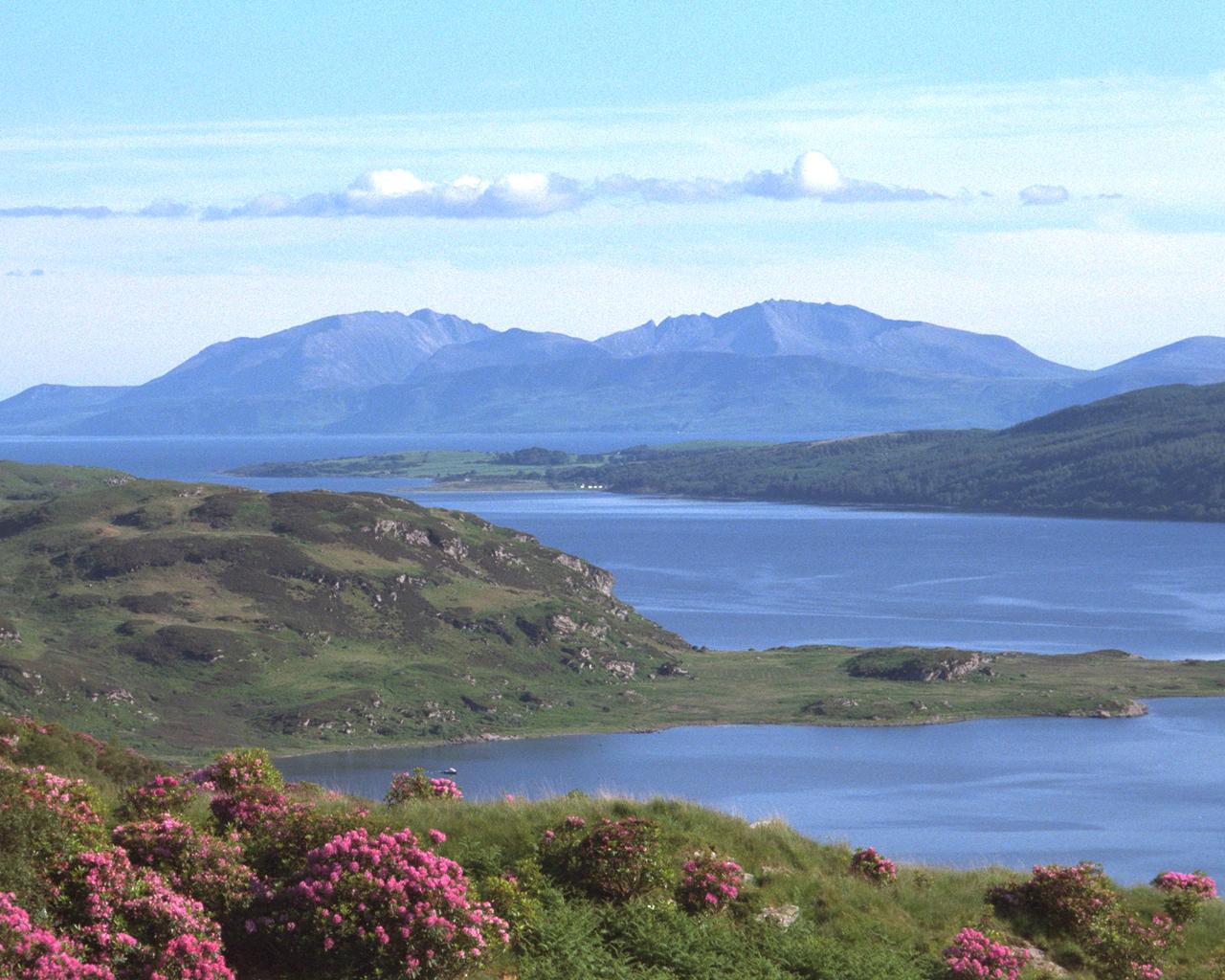
Nearly empty mile-long beaches are my idea of a good day out, and the one we visited was particularly good for beachcombing, so while MrB and the breakfastboys were busy building things out of sand and stones, The Dowager Breakfastlady and I collected sea urchin shells and razor clams. The spring green of the fields was exactly like that lovely green in the Glasgow Boys' paintings:
I'm probably making it sound a leeeetle bit more idyllic than it really was - smallest breakfastboy was in one of those moods, and the weather, whilst sunny, was not exactly balmy, but still. Retrospect and a pair of rose-tinted glasses are fine things.

All this talk of beaches is really by way of a preamble to the subject of seaweed. I bought a carton of seaweed at the supermarket the other day. Well, Whole Foods Market, not Tesco, you know. Not only do they sell seaweed, they sell different kinds of seaweed. Yeah. It's supposed to be very good for you, seaweed. It looks good for you, and it smells like the sea, and the sea's good for you, (sharks and riptides notwithstanding), and let's face it, you just know that if the Japanese are eating it, it's going to make you live to 115. Well, my research with the Great God Google tells me that it is the best source of hard-to-come-by-yet-essential iodine, has more calcium than broccoli, is high in vitamin B12 and vitamin A, and is rich in soluble fibre and protein. Hurrah. Now, what am I going to do with it? I'm going to make bread, obviously. I make little else these days. There is a recipe in Richard Bertinet's Dough, but I'm thinking that a beer bread with a briny hint of seaweed might be good. Guinness and seaweed bread, maybe? Or Oats and seaweed? Or Guinness and oats and seaweed? Hmmmm. I'll get back to you when I'm done. In the meantime, here is a picture of my beachcombed sea urchin.

The Japanese eat them as well, I believe, but this one was already uninhabited by the time I picked it up, so you'll have to make do with seaweed.
Thursday 25 April 2013
Baking on the wild side

I have mixed feelings about nettles. All my gardening books tell me that they are good, that their presence in my garden means I have fertile soil, and that I should lovingly nurture a patch of nettles because they are an ideal food for loads of beneficial insects. On the other hand, I think I have the fiercest stinging nettles in the known universe growing on my patch. You can honestly feel the sting for days afterwards.
Nettles are also, it turns out, frightfully good for you: high in vitamin A, vitamin C, iron, potassium, manganese, and calcium. Not bad for something that grows like, well, a weed, in my garden. I love the idea of eating your weeds - possibly the only way in which I can demonstrate mastery over my very unruly garden is by eating it. And early spring is the perfect time to eat nettles (I think in this bizarre year late April counts as 'early spring', right?). You pick just the very young growing tips.
Most people who cook with nettles make soup, but you can also chop them into a tortilla, or use them to make a pesto (in the same way you might with wild garlic), but I decided to use them to make some bread, after I came across a recipe for nettle knots in Hanne Risgaard's lovely book 'Home Baked'. This has to be the most beautifully illustrated cookbook ever - full of photos of billowing fields of wheat and rye in her native Denmark, where she grows and mills cereal crops on her family farm.Being Danish, it has a Scandinavian flavour - lots of rye, but also lots of spelt, and some interesting ingredients like elderflowers and, as here, nettles, that can be picked wild.
Anyway, I digress. The recipe uses chopped nettles in a fairly rich dough which includes milk and a beaten egg as the liquid. I used unbleached white flour from Gilchester's Mill in Northumberland, with a touch of wholemeal. The end result may look like one of those fake dog poos that so amuse the smallest breakfastboy, but do not be fooled: inside they are soft and lovely, not dissimilar to a bagel. I toasted some cheese on top of a split knot for lunch and we're having the rest with a butternut squash and coconut soup for dinner tonight. And never fear, there's not a hint of a sting when you eat them. However, I must point out that even once finely chopped - and that is the best use for a mezzaluna I have yet found - the stings are very much present when you knead the dough. I didn't follow the kneading instructions, as I'm still on a kneading-lite regime on account of my dodgy wrists, but used Dan Lepard's method of giving the dough a number of very light, quick kneads, and I then let it rise overnight in the fridge to avoid middle of the night baking. But even so, I managed to sustain a few stings. You might want to wear gloves, but that seems a bit weird.

So, if you're doing a little spring weeding in the garden, or foraging in the woods for wild garlic, spare a thought for nettles and get picking (carefully). If you can't get hold of the recipe I used, you could substitute nettles in another bread recipe - perhaps one that uses chives or wild garlic, or even one with seaweed like the one in Richard Bertinet's Dough. You get the picture. Jazz baking.

Sunday 14 April 2013
Scottish bread #2 - gather round Aberdonians and lovers of butter.
I am currently on a no-knead regime, on doctor's orders. Several months of somewhat over-enthusiastic breadmaking has left me with carpal tunnel syndrome in both wrists, so I'm finding bread that doesn't need kneading (hello there rye!) and using my bread machine for the rest of the hard graft. So, bread machine it was today for the inaugural rowie bake (see here if you have no idea what I'm talking about). First things first, if you're thinking of giving these a bash - you'll need to set aside the best part of a day for this. Like croissants, there are rounds of adding fat, resting, adding fat, resting. It's perfect for those days when you have other things to do around the house, but hopeless for those days when you have two small boys hurling toys around and whirling about the house like small tornadoes. Which is why <ahem> I have sent my ailing man to the park with them while I am sitting here with a cup of tea and the computer for company.
You need to start by making a basic dough (flour, water, yeast, sugar, salt), in my case in the bread machine, though you could equally do it by hand or in a mixer. I used the pizza setting for this, which takes 45 minutes, rather than the regular dough setting, as there was going to be plenty more opportunity for the dough to have a good rest. Now, as this blog should really reflect the reality of my culinary experience, I'll tell you that when I opened the bread machine, I was met by a gloopy batter rather than a nice silky dough. The recipe instructed me to roll it out, so I figured that this could not be the way things were meant to be. So, I managed to scoop it out with a scraper and added quite a lot more flour and give it a quick knead before continuing to the next step. As a result, I've adjusted the original quantities, which I gleaned from a number of sources, including Elizabeth David's English Bread and Yeast Cookery, and adapted to be enough for about 8 rowies. I'll add at this point that I am very far from being a mathematical genius, so it may be that my tinkering is what led to the gloop in the bread machine. Anyway, what I've used in the recipe below should be about right, and if it isn't, then add a bit more flour or water until you have a soft, but not sticky dough. The method is basically the same as making flaky pastry or croissants. If you have a warm kitchen, it's a good idea to refrigerate the dough while it's resting.
Before I go any further, I would also like to offer you the following piece of advice. On NO account should you do what I did and use a baking tray without a lip all round for baking these.
The rowies will produce melted fat, and without a lip, the fat will run off the tray and all over your oven, and if you are unlucky, you will come into the kitchen to find billows of acrid smoke emerging from your oven and actual flames in your oven. This is not a good thing. I hope you will agree that despite the fact that my rowies had to be hastily whipped from the oven and left on the side while I extinguished flames, cleaned up the mess and ran about opening windows and shouting obscenities at the top of my voice before reheating the oven and slinging them back in, they have turned out nae bad. They do however, have a faint hint of burning rubber in the flavour which is not entirely desireable.
Rowies (makes 8)
for the basic dough:
1 tsp quick yeast
300g strong white flour
1 1/2 tsp caster sugar
1 tsp salt
225ml water
then:
140g butter
50g lard (both at room temperature)
1. Make a dough with the basic dough ingredients. If using a bread machine, follow manufacturer's instructions for order of ingredients. If making by hand, mix the ingredients together, knead until smooth and silky, cover and leave the dough for 45 mins to rest.
2. Chop the fats into small cubes, mix together and divide into 3 portions.
3. When the dough is ready, gently roll it out into a rectangle about 1.5 cm thick. Try not to knock too much air out of it - be gentle. Cover and leave it to rest for 30 mins.
4. Spread 1/3 of the fat onto the top 2/3 of the dough, then fold the other 1/3 over the middle 1/3 and then fold the top 1/3 down on the top to make an envelope. That sounds more complicated than it is. 'Fold it like a letter' is what I'm trying to say, but get the bit with no fat on into the middle.
5. Gently, trying not to tear the dough, work the dough, prodding or rolling it gently it rather than kneading it, to slowly work it out into a long rectangle again. Cover and leave for 1 hour.
6. Repeat steps 4 and 5 twice until you have used up all the fat.

7. Cut the dough into 8 pieces. Flatten them out again by prodding gently with your fingers until you have flattish round or rectangular patties, and place them on a heavily floured baking tray - SEE TIP ABOVE! You may wish to use rice flour, or fine polenta, but wheat flour is fine if that's all you have. Cover and leave for 45mins.
8. Meanwhile, heat the oven to 220C. Bake for about 15 mins until golden brown.
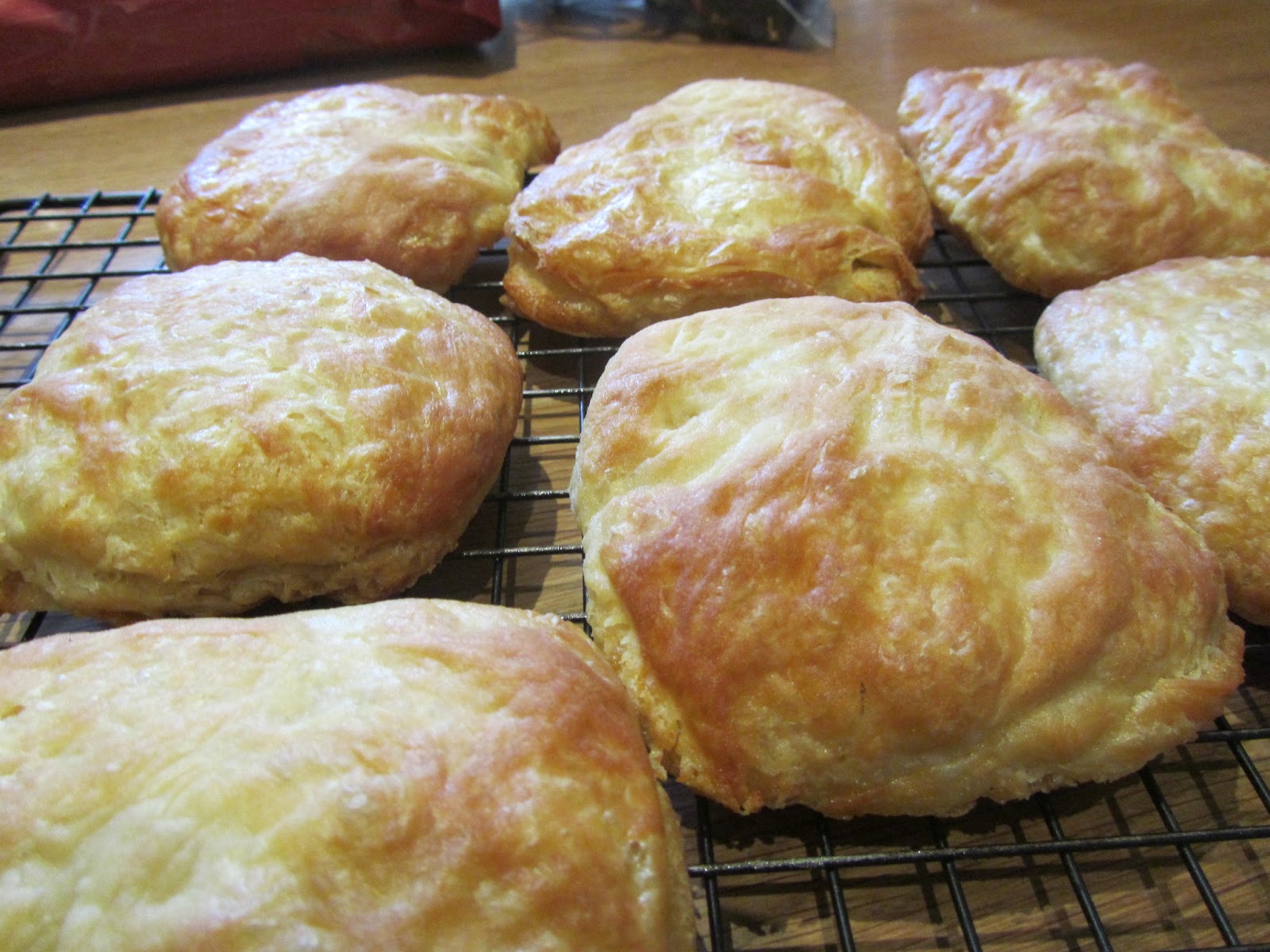

Eat with more butter if you can bear it, preferably salted. Serve with a strong cup of tea, especially if you have almost burned the house down whilst making them.
You need to start by making a basic dough (flour, water, yeast, sugar, salt), in my case in the bread machine, though you could equally do it by hand or in a mixer. I used the pizza setting for this, which takes 45 minutes, rather than the regular dough setting, as there was going to be plenty more opportunity for the dough to have a good rest. Now, as this blog should really reflect the reality of my culinary experience, I'll tell you that when I opened the bread machine, I was met by a gloopy batter rather than a nice silky dough. The recipe instructed me to roll it out, so I figured that this could not be the way things were meant to be. So, I managed to scoop it out with a scraper and added quite a lot more flour and give it a quick knead before continuing to the next step. As a result, I've adjusted the original quantities, which I gleaned from a number of sources, including Elizabeth David's English Bread and Yeast Cookery, and adapted to be enough for about 8 rowies. I'll add at this point that I am very far from being a mathematical genius, so it may be that my tinkering is what led to the gloop in the bread machine. Anyway, what I've used in the recipe below should be about right, and if it isn't, then add a bit more flour or water until you have a soft, but not sticky dough. The method is basically the same as making flaky pastry or croissants. If you have a warm kitchen, it's a good idea to refrigerate the dough while it's resting.
Before I go any further, I would also like to offer you the following piece of advice. On NO account should you do what I did and use a baking tray without a lip all round for baking these.
 |
| Don't do this (flames not shown) |
The rowies will produce melted fat, and without a lip, the fat will run off the tray and all over your oven, and if you are unlucky, you will come into the kitchen to find billows of acrid smoke emerging from your oven and actual flames in your oven. This is not a good thing. I hope you will agree that despite the fact that my rowies had to be hastily whipped from the oven and left on the side while I extinguished flames, cleaned up the mess and ran about opening windows and shouting obscenities at the top of my voice before reheating the oven and slinging them back in, they have turned out nae bad. They do however, have a faint hint of burning rubber in the flavour which is not entirely desireable.
Rowies (makes 8)
for the basic dough:
1 tsp quick yeast
300g strong white flour
1 1/2 tsp caster sugar
1 tsp salt
225ml water
then:
140g butter
50g lard (both at room temperature)
1. Make a dough with the basic dough ingredients. If using a bread machine, follow manufacturer's instructions for order of ingredients. If making by hand, mix the ingredients together, knead until smooth and silky, cover and leave the dough for 45 mins to rest.
2. Chop the fats into small cubes, mix together and divide into 3 portions.
3. When the dough is ready, gently roll it out into a rectangle about 1.5 cm thick. Try not to knock too much air out of it - be gentle. Cover and leave it to rest for 30 mins.
4. Spread 1/3 of the fat onto the top 2/3 of the dough, then fold the other 1/3 over the middle 1/3 and then fold the top 1/3 down on the top to make an envelope. That sounds more complicated than it is. 'Fold it like a letter' is what I'm trying to say, but get the bit with no fat on into the middle.
 |
| (or show them a photo. That will help) |
5. Gently, trying not to tear the dough, work the dough, prodding or rolling it gently it rather than kneading it, to slowly work it out into a long rectangle again. Cover and leave for 1 hour.
6. Repeat steps 4 and 5 twice until you have used up all the fat.
7. Cut the dough into 8 pieces. Flatten them out again by prodding gently with your fingers until you have flattish round or rectangular patties, and place them on a heavily floured baking tray - SEE TIP ABOVE! You may wish to use rice flour, or fine polenta, but wheat flour is fine if that's all you have. Cover and leave for 45mins.
8. Meanwhile, heat the oven to 220C. Bake for about 15 mins until golden brown.
Eat with more butter if you can bear it, preferably salted. Serve with a strong cup of tea, especially if you have almost burned the house down whilst making them.
Subscribe to:
Posts (Atom)